Follow one stated rule
Changing jumps and sum pyramids on pages 1-4.
Solve six kinds of original rule-based challenge: changing-step sequences, sum pyramids, balance equations, rectangle counts, route grids, and ordering constraints. Every item has a matched explained answer.
Worksheets are on pages 1-12. Explained answers are on pages 13-24. No sign-up and no watermark.
Choose a page from the actual PDF contents. The links open the complete 24-page file at your selection when supported by your PDF viewer; they are not separate single-page files.
In the print dialog, enter page 1 to print only that page. Some pages contain more than one puzzle or answer.
The actual PDF preview loads when this panel is visible.
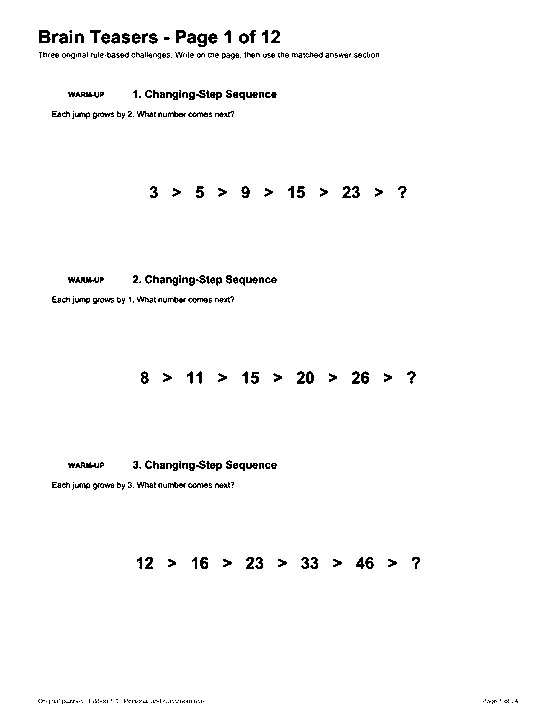
High-contrast preview: actual US Letter page 1, Brain Teasers - Page 1 of 12. Open the PDF for full-size printing. The interactive viewer can display every original page.
Open this page in the full-size PDF
Changing jumps and sum pyramids on pages 1-4.
Symbol equations and all-size rectangles on pages 5-8.
Legal routes and unique five-letter orders on pages 9-12.
Each family contains six original items. Three fit on each worksheet page, leaving room to calculate or mark a route.
Worksheet pages 1-2
6 direct rule evaluationsWorksheet pages 3-4
6 exhaustive missing-value checksWorksheet pages 5-6
6 exact two-variable systemsWorksheet pages 7-8
6 exhaustive shape countsWorksheet pages 9-10
6 path enumerationsWorksheet pages 11-12
6 unique permutation solutionsThese are actual items from the download, not decorative examples. Open an answer only when you want the explanation.
Each jump grows by 2. What number comes next?
33 — The jumps are 2, 4, 6, 8, 10; add 10 to 23 to get 33.
Each brick equals the sum of the two below it. Fill the blank.
5 — Subtract the known neighbor from its sum brick: 8 - 3 = 5. Fill bottom position 2, then add adjacent bricks to check the top 30.
Each symbol has a fixed whole-number value. Find the circle.
3 — Multiply equation 1 by 2 and equation 2 by 1, then subtract: 3 x CIRCLE = 9, so CIRCLE = 3. Substitute into equation 1: SQUARE = 8.
How many rectangles of every size are in this grid? Squares count too.
10 — Choose two of the 2 horizontal lines and two of the 5 vertical lines: 1 x 10 = 10.
Move only right or down from S to F. Blocked cells cannot be entered. How many routes?
6 — Add the ways entering each open cell from above and left. The value at F is 6, so there are 6 legal routes.
Place A-E from left to right. Use every letter once.
B - D - A - E - C — Place A third and C fifth. The B-D pair must occupy slots 1-2, since B is before E. The remaining E goes fourth: B - D - A - E - C.
This pack uses newly specified numeric, geometric, path, and ordering tasks. It does not reproduce familiar one-line riddles or reuse the site's rebuses, cryptograms, word scrambles, crosswords, Sudoku boards, full logic grids, or mazes.
Every prompt states the rule or allowed moves clearly. That removes alternative interpretations while leaving the arithmetic, counting, or deduction for the solver.
Sequences, pyramids, and balance systems are rebuilt from their stored numeric specifications.
Every rectangle, legal route, and ordering permutation is counted instead of sampled.
The build rejects duplicate problem signatures, specifications, prompts, explanations, and prior-page reuse.
Use Letter for 8.5x11-inch paper or A4 for 210x297-mm paper. Print at 100% or Actual Size. Print pages 1-12 for worksheets; answers begin on page 13.
All diagrams are vector-based and remain understandable in grayscale.
You may print copies for personal use, one classroom, a homeschool group, a library activity, or a community event. Please do not resell or redistribute the PDF files.
Yes. Pages 1-12 are worksheets and pages 13-24 are matched explained answers.
No. The pack contains newly specified numeric, geometric, route, and ordering tasks rather than familiar one-line riddles.
Yes, after previewing the instructions. The levels describe puzzle structure, not an age or ability claim.
No. Every diagram remains understandable in grayscale.
Yes. Each file uses the true paper dimensions named on its button.