Roughly grades 2-4
12x12 grids, 12 terms, and forward-only horizontal, vertical, and diagonal paths.
Explore twelve original grids from scientific inquiry and simple machines to cells, chemistry, waves, and ecosystems. The pack has three level bands, 192 distinct terms, and a matching answer for every puzzle.
Puzzles are on pages 1-12. Highlighted answers are on pages 13-24. No sign-up and no watermark.
Choose a page from the actual PDF contents. The links open the complete 24-page file at your selection when supported by your PDF viewer; they are not separate single-page files.
In the print dialog, enter page 1 to print only that page. Some pages contain more than one puzzle or answer.
The actual PDF preview loads when this panel is visible.
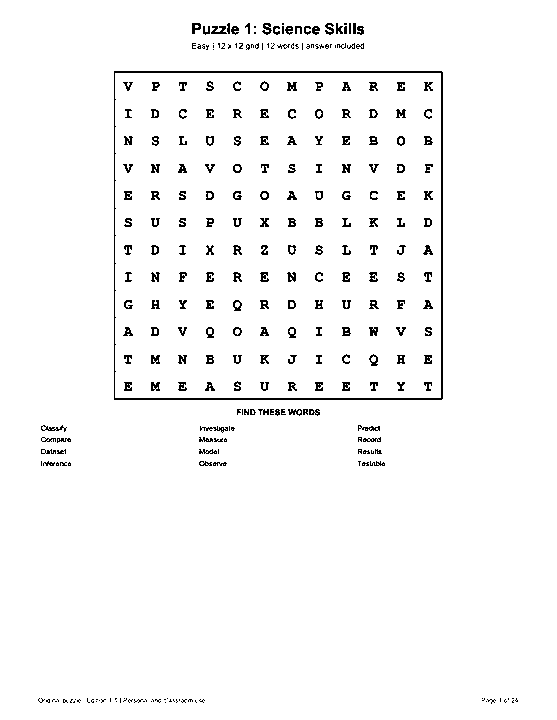
High-contrast preview: actual US Letter page 1, Puzzle 1: Science Skills. Open the PDF for full-size printing. The interactive viewer can display every original page.
Open this page in the full-size PDF
These bands are practical guides, not universal curriculum labels. Preview the words and choose by current science vocabulary and reading comfort.
12x12 grids, 12 terms, and forward-only horizontal, vertical, and diagonal paths.
15x15 grids, 16 terms, all eight directions, and planned intersections.
18x18 grids, 20 terms, longer vocabulary, reverse paths, diagonals, and denser overlaps.
Each subject has an independent word list, a distinct grid, and its own highlighted answer page. Phrases appear without spaces in the grid.
12x12 · 12 terms · answer page 13
Actions used to ask questions, collect observations, compare results, and build testable explanations.12x12 · 12 terms · answer page 14
Shared characteristics and needs of organisms, including response, reproduction, habitat, adaptation, and life cycles.12x12 · 12 terms · answer page 15
Observable properties and changes of solids, liquids, gases, and mixtures.12x12 · 12 terms · answer page 16
The six simple-machine ideas, including the wheel and axle and inclined plane represented here by RAMP.15x15 · 16 terms · answer page 17
Major structures and processes used when introducing interacting human body systems.15x15 · 16 terms · answer page 18
Rock types and processes that reshape Earth's crust, from weathering and erosion to uplift and plate boundaries.15x15 · 16 terms · answer page 19
Ways water moves and changes state through the atmosphere, surface, ground, and living plants.15x15 · 16 terms · answer page 20
Solar-system structure and vocabulary for planets, small bodies, the Sun, moons, probes, and orbital motion.18x18 · 20 terms · answer page 21
Cell structures plus introductory DNA, chromosome, gene, inheritance, and variation vocabulary.18x18 · 20 terms · answer page 22
Atomic structure, the periodic table, bonding, reactions, solutions, concentration, acids, and bases.18x18 · 20 terms · answer page 23
Motion and forces alongside mechanical waves, sound, light, frequency, amplitude, and wavelength.18x18 · 20 terms · answer page 24
Feeding roles, interactions, population limits, succession, species change, and biological diversity.These are the actual Science Skills, Earth's Changing Surface, and Chemistry Foundations puzzles—not decorative mockups.
A word search supports visual recognition and spelling of terms; it does not teach a complete concept by itself. The topic notes describe what belongs together, while a teacher, book, demonstration, or discussion supplies the explanation.
The lists were reviewed against primary educational references. Genetics stays descriptive rather than medical, and the page does not claim to match every school curriculum.
Choose three found terms and write a short accurate definition for each.
Group words by structure, process, material, system, or another useful rule.
Select related terms and add them as labels to a simple diagram.
Write one accurate sentence connecting two words from the same grid.
Every target is reconstructed from its saved start, direction, and endpoint in the final letter grid.
The scanner checks all eight directions and requires each listed target to appear exactly once.
Every final grid is stored with its own matching answer. Familiar science vocabulary can recur in independently built topic packs.
Use Letter for 8.5x11-inch paper or A4 for 210x297-mm paper. Print at 100% or Actual Size. Print pages 1-12 for activities; answers begin on page 13.
Black-and-white printing works for the puzzles. The answer highlighting remains visible in grayscale.
You may print copies for personal use, one classroom, a homeschool group, a library activity, or a community science event. Please do not resell or redistribute the PDF files.
The progression is roughly grades 2-8. Preview each word list and choose by current reading and vocabulary familiarity.
Yes. Puzzles are on pages 1-12 and matching highlighted answers are on pages 13-24.
No. They are vocabulary-recognition activities designed to accompany instruction, reading, demonstrations, or review.
Spaces and punctuation are removed, so PERIODIC TABLE appears as PERIODICTABLE.
Yes. Each PDF uses the true paper dimensions named on its download button.
Puzzle 1 includes OBSERVE, MEASURE, and INFERENCE. Finding a word is not the same as understanding the idea: use this short example to connect three terms.
Notice that a puddle is smaller in the afternoon: that is an observation. Mark its edge or measure its width at two times to record a comparison. Keep the units and observation conditions the same.
“Some water evaporated” is an inference drawn from observations, not something proved by the word search. Rain, drainage, or a changing measuring point could affect the comparison. Use further observations to test the explanation rather than treating one result as proof.